Pianotech

Expand all | Collapse all

Steinway Console hammer return/key weighting

  • 1.  Steinway Console hammer return/key weighting

    Registered Piano Technician
    Posted 01-31-2018 19:45
    <g class="gr_ gr_71 gr-alert gr_gramm gr_inline_cards gr_run_anim Punctuation only-ins replaceWithoutSep" id="71" data-gr-id="71">Hi</g> there list,

    I have a client with a mid-century Steinway Console that is in very good shape for its age. I've seen several of these over the years, and they seem to have this issue: The keys do not like to return to their rest position. The action feels very light and "fly away". Steinways are the only console pianos I have seen that weight the front of the key instead of the back. It really makes setting lost motion impossible. 

    I'm tempted to just add a weight to the back of the keys, but it seems to go against the intent of the design. Strengthening a few of the jack springs helps a little. It seems that for this design to work it needs an extra strong jack spring to help push the back of the key to rest. 

    I'm curious if others have come up with any good solutions for these actions?

    Ryan

    ------------------------------
    Ryan Sowers
    Olympia WA
    360-705-4160
    ------------------------------


  • 2.  RE: Steinway Console hammer return/key weighting

    Registered Piano Technician
    Posted 01-31-2018 22:35
    "Been there, done that." In other words, thought replacing the jack springs would be the fix. Not in my case. I should have weighted the keys. Does the piano have Billings flanges (made of brass pressed metal)? I think there was veridigris happening in the hammer butt bushings  but I avoided repinning or rebushing because the flanges were fragile and not available at that time.
    Good luck!

    ------------------------------
    Patrick Draine
    Billerica MA
    978-663-9690
    ------------------------------


  • 3.  RE: Steinway Console hammer return/key weighting

    Registered Piano Technician
    Posted 02-01-2018 00:28
    Hi Ryan:
    Couple of things come to mind. Check the wippen cushion felt. If it is dimpled, it will improve if you replace the felt. Also, try adjusting the hammer return springs. It may be possible to remove some shims from the spring rail to move it closer to the brackets and increase all the spring tension. The keys must have been weighed with the spring tension when new, and now they have weakened a bit. I don't think the jack spring will do that much. Also, check the damper lever felt and spoons for corrosion and roughness. Weak damper springs will also not help lift the key as they would if they were strong. Then, there's Jiffy leads (tacky but they work).
    FWIW.
    Paul McCloud
    San Dieog


    Hi there list,

    I have a client with a mid-century Steinway Console that is in very good shape for its age. I've seen several of these over the years, and they seem to have this issue: The keys do not like to return to their rest position. The action feels very light and "fly away". Steinways are the only console pianos I have seen that weight the front of the key instead of the back. It really makes setting lost motion impossible.

    I'm tempted to just add a weight to the back of the keys, but it seems to go against the intent of the design. Strengthening a few of the jack springs helps a little. It seems that for this design to work it needs an extra strong jack spring to help push the back of the key to rest.

    I'm curious if others have come up with any good solutions for these actions?

    Ryan

    ------------------------------
    Ryan Sowers
    Olympia WA
    360-705-4160


  • 4.  RE: Steinway Console hammer return/key weighting

    Posted 02-01-2018 05:50
    Check balance hole height. Ream and ease. Ease Bushings. Add back lead or remove front lead.

    ------------------------------
    Regards,

    Jon Page


  • 5.  RE: Steinway Console hammer return/key weighting

    Registered Piano Technician
    Posted 02-01-2018 07:54
    Hi Ryan,
    I've added lead to the back of one of these pianos, and it worked out well - the keys returned more easily, and lost motion was more consistent. I wouldn't worry about the intent of design.

    All the best,
    Jon


  • 6.  RE: Steinway Console hammer return/key weighting

    Registered Piano Technician
    Posted 02-01-2018 11:31
    back leading the keys is probably the easiest way to go. The <g class="gr_ gr_32 gr-alert gr_spell gr_inline_cards gr_run_anim ContextualSpelling ins-del multiReplace" id="32" data-gr-id="32">touchweight</g> could definitely be improved with more weight in the system. I've also been thinking about <g class="gr_ gr_115 gr-alert gr_spell gr_inline_cards gr_run_anim ContextualSpelling ins-del" id="115" data-gr-id="115">weighting</g> the <g class="gr_ gr_122 gr-alert gr_spell gr_inline_cards gr_run_anim ContextualSpelling" id="122" data-gr-id="122">wippen</g> by gluing a split fishing lead on the bottom of the backcheck or bridle wire. Has anyone tried this?

    ------------------------------
    Ryan Sowers
    Olympia WA
    360-705-4160
    ------------------------------


  • 7.  RE: Steinway Console hammer return/key weighting

    Posted 02-02-2018 16:00
    Hi, Ryan

    Did the Steinway console by any chance look like this?


    I just came across one of these, which had lived in Texas till recently, and I found it so unusual with so many things I have never seen before that I'm considering making a photo essay about it for the Journal. It was in fairly rough shape, but is responding well to attention. Among other problems, the front-weighted keys and some careless work by someone who replaced the ivory with plastic made the keys seem very out of level. I started to level them, and realized that the erratic lost motion was most of the trouble, since the keys would fall till the capstan was touching the wippen cushion. I got a lot more sanity by turning up the capstans till the hammers were just slightly off the rail, then leveling the keys. Then I turned the capstans down uniformly till there was just a trace of lost motion.

    The keys taper front to back instead of having the top and bottom edges parallel, and they have no leads in them.

    The soundboard miraculously survived early years in Houston followed by decades in Waco, without cracking. That wood was wasted on glider wings!


    ------------------------------
    Susan Kline
    Philomath, Oregon
    ------------------------------


  • 8.  RE: Steinway Console hammer return/key weighting

    Registered Piano Technician
    Posted 02-02-2018 20:26
    Susan,

    That's a Model P. Not a bad piano. Seen several, and had to do major reconstruction on one missing casters and wood. 

    Pwg

    ------------------------------
    Peter Grey
    Stratham NH
    603-686-2395
    pianodoctor57@gmail.com
    ------------------------------


  • 9.  RE: Steinway Console hammer return/key weighting

    Registered Piano Technician
    Posted 02-09-2018 01:01
    Hi to you too Susan! Good to hear from you! 

    That is a pretty piano, and I know exactly what you are talking about with the lost motion and key level. I've had that same experience - meticulously try to level the keys, and then you adjust the lost motion and everything goes a little wonky. Not a very lucrative way to spend your time!

    The Steinway console in question is this type: 
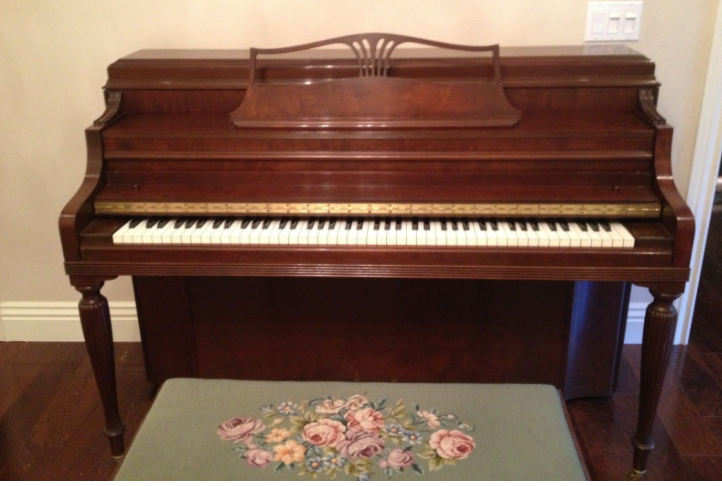
    Steinway Console

    ------------------------------
    Ryan Sowers
    Olympia WA
    360-705-4160
    ------------------------------


  • 10.  RE: Steinway Console hammer return/key weighting

    Posted 02-09-2018 02:44
    So, Ryan, yours is a little bit different.

    I don't think mine had any leads in the keys at all. I'll check when I go there again on Monday.

    I wasted very little time with key leveling before I figured out the varying lost motion and front weighting difficulty and turned up the capstans. After that the leveling went fine, and it was not hard to give each note a small amount of lost motion after the keys were level.

    I just downloaded and processed the digital photos I took on my last visit. I'm including a few here.

    I'm thinking of writing up a short photo essay for the Journal, because this piano has so many unusual features. I understand from a web search that there are more of these out there, but in almost 40 years this is the first Steinway P I've ever met.

    Unusual features:
    The keys jutting out past the edge of the case, with keytop material on the sides of the end keys.
    The tapering shape of the keys, and the lack of lead.
    The way the piano seems to be designed to look compact, while it isn't. Note the quite tall action and the quite long keys and the generous total height.
    The bass damper felt had pieces of flat felt in between the two wedge sections!
    Accelerated action, with the full decals and the balance rail half-rounds, in 1939.
    The very unusual trapwork.

    All in all, a fun piano with a very substantial sound still, and the board is amazingly intact.

    Susan

    ------------------------------
    Susan Kline
    Philomath, Oregon
    ------------------------------


  • 11.  RE: Steinway Console hammer return/key weighting

    Posted 02-10-2018 20:49
    Put some lead in those puppies! Well, maybe not that much lead - and maybe put it in the rear of the key - and maybe remove the lead in the front......

    But yes, make sure the keys are backweighted at least a couple of grams. More if you desire more downweight.


    ------------------------------
    Terry Farrell
    Farrell Piano Service, Inc.
    Brandon, Florida
    terry@farrellpiano.com
    813-684-3505
    ------------------------------


  • 12.  RE: Steinway Console hammer return/key weighting

    Posted 02-11-2018 02:40
    As you can see from the photos I sent, there ain't no lead in the front, and the rear ends are tapered so there isn't all that much wood to add lead to. 

    A very exact key leveling and very uniform and small lost motion seems to have done the trick.

    ------------------------------
    Susan Kline
    Philomath, Oregon
    ------------------------------


  • 13.  RE: Steinway Console hammer return/key weighting

    Registered Piano Technician
    Posted 02-02-2018 16:16
    That is where I'd start. Split leads are inexpensive and are relatively easy to install. Easy to remove, as well. Personally, I prefer to install lead plugs in the wippen itself but this is, of course, much more time consuming (i.e., expensive). 

    If there is room in the catcher it also helps to install a small lead plug there. 

    These are "compact" actions. They never worked all that well in their original form. But, with a little weighting and careful regulating they can be quite nice.

    ddf

    --
    Delwin D Fandrich
    Fandrich Piano Company, Inc.
    Piano Design and Manufacturing Consulting Services -- Worldwide
    6939 Foothill Ct SW -- Olympia, WA 98512 -- USA
    Phone 360.515.0119 -- Mobile 360.388.6525


  • 14.  RE: Steinway Console hammer return/key weighting

    Posted 02-02-2018 16:29

    Actually, Del, to my great surprise, this piano wasn't all that compact. It was designed to look like a compact piano, but the keys were quite long and the action wasn't nearly as compressed as normal console actions are. Apparently small pianos were getting popular, and so Steinway designed this thing to seem like a small piano, but without shrinking the innards much. The total height is more like a studio upright than a console. The weirdest thing about the case is that the keys jut forward from the case, with a wooden surround in place of a normal keyslip. In fact, the end keys have keytop material on their sides because an inch and a half or so is exposed when the piano is put together.

    As I exclaimed over this and that, the owner imagined a salesperson talking to his mother in 1939: "Ma'am, this is the best sounding compact piano on the market." "Yes," I told him, "because it is only pretending to be a compact piano."

    You'd think, as I'm coming up on 40 years in this business, I'd run out of new things to see -- but I never saw a Steinway which looked or acted like this one! Yet definitely very Steinway.


    ------------------------------
    Susan Kline
    Philomath, Oregon
    ------------------------------


  • 15.  RE: Steinway Console hammer return/key weighting

    Registered Piano Technician
    Posted 02-02-2018 16:38
    I was referring to the action stack, not the keys or the piano itself.

    ddf

    --
    Delwin D Fandrich
    Fandrich Piano Company, Inc.
    Piano Design and Manufacturing Consulting Services -- Worldwide
    6939 Foothill Ct SW -- Olympia, WA 98512 -- USA
    Phone 360.515.0119 -- Mobile 360.388.6525


  • 16.  RE: Steinway Console hammer return/key weighting

    Registered Piano Technician
    Posted 02-01-2018 11:33
    If the keys are weighted in the front, why not remove those weights rather than adding more weights to the back, Ryan (if I understand what you wrote correctly)?

    Bob Anderson
    Tucson, AZ


  • 17.  RE: Steinway Console hammer return/key weighting

    Registered Piano Technician
    Posted 02-09-2018 01:05
    Removing the front leads is what Kent Webb suggested. However, my feeling is it may not quite give enough which means I may need to not only remove front leads but still add back leads. I'd rather just do one. 

    I also don't mind making the overall key heavier. I once weighed an upright key compared to a grand key, and there is no comparison. I think having more weight in the keys makes them feel more substantial - a little more "grand like". It will also be easier to achieve a consistent down weight since I'll have more control over weight placement. Just removing the front weights will help, but I think there will be a lot of inconsistency. 

    Thanks for your responses everyone! I love this list, even though I go missing for long periods of time!

    ------------------------------
    Ryan Sowers
    Olympia WA
    360-705-4160
    ------------------------------


  • 18.  RE: Steinway Console hammer return/key weighting

    Registered Piano Technician
    Posted 02-11-2018 00:30
    I didn't see an essential point made about rebalancing vertical actions. Grand action have their "payload" weight mounted out on the end of a horizontal lever. This needs to be balanced by front leads. In vertical actions, the payload sits vertically, on top of the shank center. (…Well, not purely vertically, by then again, when at rest, the center of gravity of the hammer butt/head assembly is supported by the hammer rest rail.)

    With that great extent of the payload weight thus supported, the action is very light, and needs backloading on the lift to present a "normal" resistance, and on the return, simply to make it back where it started.

    I like Del's idea about leading the whippens, to avoid any disconnection between the key and the next lever up when the parts return. Similar to the effect that many pianists notice with grand rep helper springs. Similar effect, but opposite treatment (because the need in rebalancing the grand and vertical actions is opposite).

    ------------------------------
    William Ballard RPT
    WBPS
    Saxtons River VT
    802-869-9107

    "Our lives contain a thousand springs
    and dies if one be gone
    Strange that a harp of a thousand strings
    should keep in tune so long."
    ...........Dr. Watts, "The Continental Harmony,1774
    +++++++++++++++++++++
    ------------------------------