Micah, Thank you for raising excellent points regarding moderators. And thank you and others for your service. Any jabs were not meant to be personal and, as you point out, jabs should be directed towards the guidelines. I apologize to all for wandering off topic and for perceived jabs.
Original Message:
Sent: 06-17-2025 02:43
From: Micah Sundholm
Subject: FW Spreadsheet for Renner KMD
David,
I have verified on my end that my message was sent to you yesterday offering to edit the post and replace it, since I didn't want to disrupt the technical discourse if possible. I can provide a screenshot to verify, if you want. Feel free to contact me directly instead of dropping things on a forum where I might miss them. I'm always happy to answer questions or verify things.
re; the jabs towards myself and my team from several members here - I would gently remind everyone we are VOLUNTEERS that just want to keep the PTG forums an effective place for business to occur. This Task Group has a very high turnover rate, and the current team was not active during Covid or a part of whatever moderation occurred then. It's not hard to understand why, given the punching bag some have turned us into.
There are Community Guidelines you all agreed to follow by using this platform. We are enforcing those guidelines when things are reported and ruled to be in violation (such as an obviously political sticker/image…), but we DO NOT actively police comments. It's fine if you disagree with this, but instead of beating down your fellow PTG members, volunteers, and colleagues, that give a significant amount of their time, perhaps consider submitting an RFA to change the Guidelines, joining the Communications Task Group to influence future moderation, or speak at Council and raise your concerns to the membership and the Board.
I am resigning this position in July at Convention. I wish the next Chair and Communications team good luck and godspeed, and welcome new volunteers. I've done my best with the cumbersome tools available, and have tried to provide a degree of transparency that I personally feel has been lacking in this role in the past that the membership deserves.
Also, I would suggest creating a new thread on PTG-L if you would like to continue this kind of moderation discussion, which I fully welcome and am happy to participate in.
------------------------------
Micah Sundholm - RPT
Summit Piano Service
Eugene, OR
------------------------------
Original Message:
Sent: 06-16-2025 23:01
From: David Love
Subject: FW Spreadsheet for Renner KMD
I am reposting this response without the cartoon as the moderator suggested would be done. I tried to send a message to that effect to the "contact us" link as instructed, which, of course, doesn't work. Why am I not surprised. If you feel the need to remove this for some reason, please advise me in advance.
It might be noted that the moderator claims to have sent me an offer to repost if the cartoon were removed. Never received. You might look into that. A better system of option to edit before just unannounced censoring would be preferable, in my opinion.
Not looking for further discussion here. The post and its intention speaks for itself and the offer of the spread sheets for general use, if desired, was genuine with no strings attached.
This reply explains why the FW is not a "false read" as claimed but a reliable indicator, if used properly with other variables, of how to achieve desired levels of inertia and the proper combination of SW and AR that leads to that. In the various methods cited, all roads lead to Rome, as it were. This is one simple method of getting there. I won't comment here further on the references to friction or aftertouch that were part of that post because they are irrelevant in this discussion. There are other non sequiturs in there as well, for example; "the reason its (sic) been accepted for so long..." which I might comment on if I could fathom what was meant. The post to which I was replying is copied at the bottom for context. I'm waiting for someone to say "but mass is not the same as weight". No, it isn't. But as long as we're talking about balancing actions here on earth, the two terms are interchangeable--I wanted to get ahead of that. If you ship off to the Moon or Mars, of course, you will have to reconsider. And Godspeed.
---------------------------------------------------------------------------------------------------------------------
Subject: RE: FW Spreadsheet for Renner KMD
That's incorrect. The FW required to achieve a targeted BW is directly proportional to the relationship between the AR and the SW and that relationship is the main driver of inertia. Key lead location is a separate matter, not inconsequential but not that significant in this part of the discussion.
If you have an AR of 6.0 and a SW that for a BW of 37 grams requires a FW of 32 grams, that AR:SW relationship will yield some specific level of inertia primarily driven by the AR:SW relationship with a smaller contribution by the key and the leads and virtually no contribution by the wippen (see Gravagne's, Voit's or Rhodes' comments on that subject for reference.)
Now, if you increase the SW in that system by 1 gram with the same target of 37g balance weight, you will require a FW of + 6 grams to achieve that. An AR of 6.0 means a change in the SW of 1 gram yields a change of 6 grams at the key and will require adding 6 grams of FW to offset that. Basic concept. The inertia will necessarily be higher in this iteration because the mass being accelerated by the same AR is higher (not to mention a small but measurable increase in the inertia because of the added lead). That change is reflected in the FW required to achieve the requisite BW and is always proportional to the change in inertia.
Let me restate; changes in inertia will always be proportional to the FW change if the two other variables are held constant, in our case the BW and the AR.
So in the Stanwood system, he has determined, by outlining the FW maximum, when you are crossing that FW ceiling that is an indication that the AR:SW relationship is not advantageous.
Obviously, there are some ways to confound those conclusions if you don't hold the BW and AR constant. But you are then comparing apples to oranges. Only if the BW and AR remain constant can you compare the two AR:SW relationships and interpret that through the FW levels AND those levels are note specific with higher ceilings in the bass and lower ceilings in the treble (see my spreadsheet for clarification).
In the "Actions to Die For" method put forth by Fandrich and Rhodes, the ITF number they derive is based on this relationship (primarily) because that's the main driver of inertia. In the Gravagne system the conclusion he draws about ideal hammer weight based on measuring the levers takes into account the same relationship. In the Stanwood system the same principle applies.
My simplified system for determining proper levels of inertia and the correct AR:SW relationship starts with a presetting a FW target of about 80-85% of FW maximum as outlined by Stanwood (though my numbers differ just slightly). For me, and by my analysis and discussions with both Gravagne and Rhodes, that is the sweet spot. By presetting the FW and finding the SW that yields a normal BW of 36 - 38 grams you will guarantee an AR:SW relationship that produces an action with inertia in the desired zone, an action to die for, or whatever moniker you wish to assign. It works, and it works every time.
What happens when you wander outside of that target by, for example, choosing a BW target of 42 grams or of 32 grams? That's for another discussion but if you think about it long enough you will see that FW must be considered along with the target BW. Those two variables alone, however, will tell you a lot in assessing an action. For example, let's say you have an action that has a BW of 45 grams and a FW that is already 100% of maximum or simply has a lot of lead to suspicious levels. To bring that action down to a compliant BW in this system you would have to further exceed the 100% value by another 8 grams or so and that would be an indication that you have to alter the AR to make it work properly, at least in terms of controlling inertia.
Similarly, if you have an action that weighs off at 32 grams BW and the FWs are low, around 70% of maximum then you can assume, correctly, that removing yet more lead to raise the BW will put that action below a minimum threshold of FW (we haven't really talked about that but there is a floor as well as a ceiling). In that case, the inertia will be predictably very low, too low in fact. Actions where the inertia is too low don't give adequate feedback to the player, especially high level players. So don't get too hung up on low inertia or that lower must be better. There is a point of diminishing returns.
But this is an easy way to quickly assess an action by just measuring the BW and seeing what the lead pattern is on a given note. If you are familiar with the approximate FW yield for certain lead patterns you can almost assess where this action is by visual inspection and a BW measurement. The classic 3-2-1-0 pattern or ever the more modern 4-3-2-1-0 pattern across the scale (1/2" leads) is probably going to be in the ballpark. So, if those patterns yield a reasonable BW of 36-38 grams you likely don't have an AR reconfiguration problem. Of course, that won't substitute for actual on the bench analysis but it's a good quick check and you won't end up doing something like this:
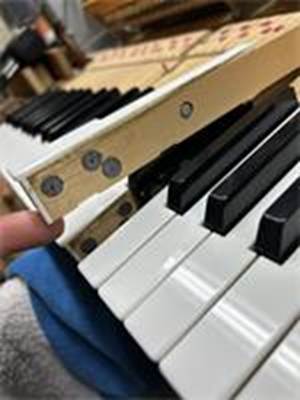
These principles are pretty basic and also reliable. The spreadsheet I posted gives you a way to assess the proper SW to accompany any given action and show whether or not a modification of the action ratio either via new knuckle position or, maybe, a capstan move, is necessary.
David Love RPT
www.davidlovepianos.com
davidlovepianos@comcast.net
415 407 8320