Jeffrey
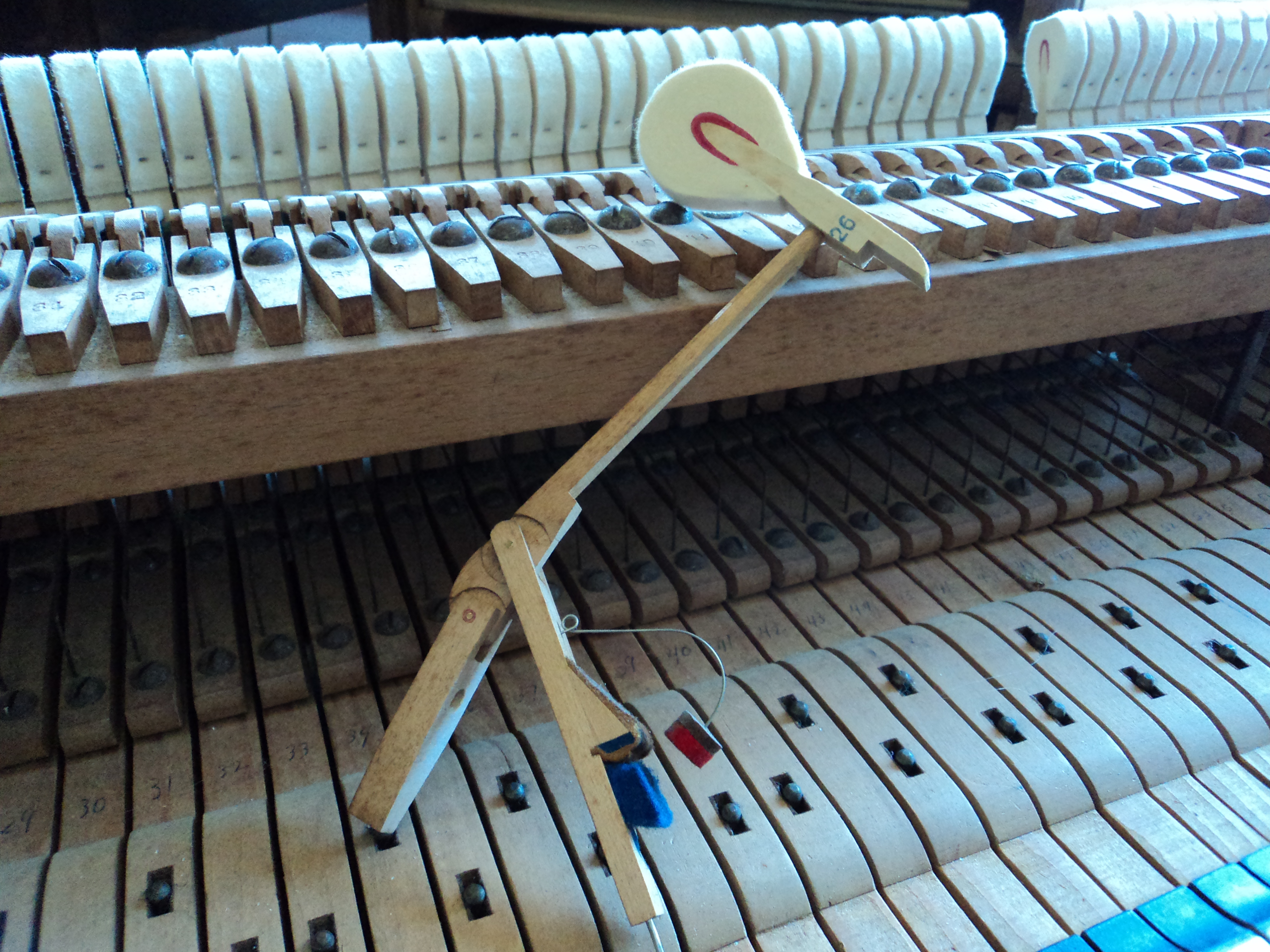
This Bluthner actiion is also known as the 'three spring action' - for obvious reasons.
Here is the set-up procedure for this old action from an early Bluthner Handbook. for Uprights and Grands. First the Upright:
Advice on how to produce a good touch on the
Bluthner Upright Pianoforte
"The separate operations must be carried out strictly in the following order"
1. Setting-up: On striking and then then allowing the key to rise slowly, the jack should fall easily into position.
2. Set-off: with the aid of the set-off dolly, the set-off is adjusted in such a way that the hammer head releases 3mm from the bass and 2mm from the treble strings.
3. Checks: The hammer should check 18mm from the strings.
4. Damping: The spoon on the end of the action lever should make contact with the tail of the damper when the nose of the hammer is at hals-blow.
5. Touch: By slowly depressig the key the hammer head is brought to the set-off point. Then by further light pressure on the key, the hammer head should fall back. The touch depth should be 10.5mm.
Advice on how to produce a good touch on the
Bluthner Action in a Bluthner Grand
The necessary operations must be carried out strictly in the following order.
The fitting of the BLUTHNER-action is based on a touch-depth of 9 mm and on a hammer-blow of 43 mm (originally 45mm)
1. The hammer flange screws should be tightened. The hammerheads must then be spaced exactly on the strings.
2. Setting-up. The jack mus be so adjusted, by means of the carriage which is screwed on to the key, that it drops quite easliy under the nose of the abstract. The guide-pin of the abstract must be straight and vertical.
3. Set-off. The hammers should release 1.5mm from the steel strings and half a string thickness from the bass strings. The set-off screws for this adjustment are situated on the hammer rest rail.
4. Touch. Contrary to the Erard action, the touch is made quite firm. The key is depressed slowly on to the touch-baize, after which the hammer should continue to rise 1mm, till it releases, so that it checks only on striking the key strongly. (No after-touch).
5. Checks. The checks should be adjusted at a slightly freater angle than on the Erard actiion. The check point is 24mm above the normal hammer tail line.
6, Drop: The right-angled repetition spring which controls the drop should have a thickness of 0.85mm. in the treble, 0.95mm. in the middle range and 1mm. in the bass; the guide pin of the abstract must move easily in the bridge leathers so that the abstract drops of its own weight. The repetition springs must move freely in the abstract felt clips and by pressure of either side of the right angled spring, the drop is controlled. The hammer head should release 3mm from the steel strings.
7. It is now necessary again to check the touch throughout.
8. The dampers should lift when the keys are half depressed.
9. The damper shade-rail must be adjusted in such a way that when depressing the sharps, there is very little play.
10. The coiled spring which is attached to the abstract should in the normal position of the key not rest on the jack, but remain about 3mm. from it.An even touch is of greatest importance.
I hope this is of some use to all involved with the old Bluthner pianos.
No-one has mentioned that the pitch of the Aliquot strings is both scaled and pitched one 8ve above the note to which it is attached. The exception is at the top where one 8ve (or so) is both by pitch and scaling the same as the note to which it is attached.
In these three spring grands I always have some brass spring of the correct diameter in my tool bag to replace those I find broken. A bit of this spring stuff makes a useful drill-bit for drilling into the key stick next to the broken-off old spring.
Michael UK
------------------------------
Michael Gamble
semi retired
Brighton
01273813612
Original Message:
Sent: 11-22-2015 15:22
From: Jeffrey Hickey
Subject: tuning a Bluthner
Dear Ryan,
Perhaps the more recent stringing helps with my client's piano, as the tone and clarity are quite nice. Perhaps you can persuade them to restring, refurbish....(gasp!) even rebuild? Truly, I do enjoy this piano. And the action is interesting, too. Bluthner Patent Action.....
------------------------------
Jeffrey T. Hickey, RPT
Oregon Coast Piano Services
TunerJeff440@aol.com
Pacific Northwest VP