Pianotech

Expand all | Collapse all

A review of Steven Norsworthy's YouTube video: The Piano Sound is a Moving Target

  • 1.  A review of Steven Norsworthy's YouTube video: The Piano Sound is a Moving Target

    Registered Piano Technician
    Posted 06-27-2024 05:34

    Over the last several months I've watched with interest many of the thought provoking videos published by Steven Norsworthy. Many of those videos contain bold assertions that I think could use some peer review. Since the preferred medium for Steven's publications here seems to be YouTube presentations advertised on piano forums, I will follow that format with my own YouTube presentation. My hope is that it will help people better understand some of the more technical aspects of Steven's signal processing analysis and push back on some of what I see as shortcomings in some of the techniques employed in his analyses. 

    I hope you find the video informative, or at least mildly interesting. 

    https://youtu.be/HNPRTHCSt2Q?si=zs3iF4wILEFbrNrI


    ------------------------------
    Anthony Willey, RPT
    http://willeypianotuning.com
    http://pianometer.com
    ------------------------------


  • 2.  RE: A review of Steven Norsworthy's YouTube video: The Piano Sound is a Moving Target

    Registered Piano Technician
    Posted 06-27-2024 08:40

    Thanks for doing this, Anthony.  It clearly took a lot of time to put this together.

    One question:

    At about the 18:30 mark in your video you say "So by averaging together multiple partials, we're basically getting a stable reproducible pitch, no matter where you are in position, and no matter where you are in time."  I think your 4 charts also show that you're getting an accurate estimation of the pitch regardless of the chosen sensor as well.  Yes/No?


    ------------------------------
    Christopher Storch RPT
    Belmont MA
    (617) 489-6436
    ------------------------------


  • 3.  RE: A review of Steven Norsworthy's YouTube video: The Piano Sound is a Moving Target

    Registered Piano Technician
    Posted 06-27-2024 11:08

    At about the 18:30 mark in your video you say "So by averaging together multiple partials, we're basically getting a stable reproducible pitch, no matter where you are in position, and no matter where you are in time."  I think your 4 charts also show that you're getting an accurate estimation of the pitch regardless of the chosen sensor as well.  Yes/No?

    My opinion alone, as I can't speak for Anthony -- but yes, that's the correct conclusion from the last set of graphs.


    ------------------------------
    Nathan Monteleone RPT
    Fort Worth TX
    (817) 675-9494
    nbmont@gmail.com
    ------------------------------


  • 4.  RE: A review of Steven Norsworthy's YouTube video: The Piano Sound is a Moving Target

    Registered Piano Technician
    Posted 06-27-2024 10:47
    Anthony,

    Thank you. Your efforts are hugely appreciated.


  • 5.  RE: A review of Steven Norsworthy's YouTube video: The Piano Sound is a Moving Target

    Registered Piano Technician
    Posted 06-27-2024 11:23

    Excellent video Anthony.  I appreciate that you are probably placed in a tough spot here as an ETD developer yourself, and may yet face accusations of simply promoting your own product.  But ultimately we don't have _that_ many folks in the community with the engineering wherewithal to really dig down to the truth of the matter on these subjects, so I think we need the ETD experts to weigh in.  Thanks for sharing your knowledge and explaining all of this so clearly.

    To anyone concerned about business conflicts of interest, I don't have one here.  So I suppose I can offer some reassurance (albeit backed by a relatively lame B.S. in Computer Science) that the technical information in this video is correct.


    ------------------------------
    Nathan Monteleone RPT
    Fort Worth TX
    (817) 675-9494
    nbmont@gmail.com
    ------------------------------


  • 6.  RE: A review of Steven Norsworthy's YouTube video: The Piano Sound is a Moving Target

    Posted 06-27-2024 11:46

    Thanks for putting this together Anthony! It was very interesting and informative. 


    ------------------------------
    "That Tuning Guy"
    Scott Kerns
    Lincoln, Nebraska
    www.thattuningguy.com
    ------------------------------


  • 7.  RE: A review of Steven Norsworthy's YouTube video: The Piano Sound is a Moving Target

    Registered Piano Technician
    Posted 06-27-2024 12:30

    It's interesting that you have agreed with Steve that the ideal window of time to tune is around a half second.  The impact sound, ie., noise, is of course to be ignored.  This window of time is easily defined using another app which has a freeze indicator.  Having used this feature and tuning to this time window, I am able to get consistent and accurate results from string to string of a unison so that the result is clean without having to tax my ears.  There are some anomalies, of course, where I must use my ears.  But when I'm done, I have very few notes that require touching up.  The better quality pianos are easier, and have less false beats of course, so I rely upon the app.  Lesser quality pianos need the ear, even if tuning them is not done during the half-second window.  Doing this method has improved my tuning results, and my clients like it also.  The sound is more bell-like and "crisp" because the unison strings are tuned during the same time window.  For me, this is the key to fine tuning. 
    The point of Steve's video is to show that there is a drifting of the partials at different rates over time.  Whether you tune to a later time window or not, attack vs decay, introduces a more uncertain result.  Indeed, as you pointed out, you are going to get a different measurement depending upon when and how long the measurement is done.  Most multi-partial apps ignore the first .1 second of impact noise, so that's not an issue.  But when you're tuning 3 strings individually, there is going to be a unique variation in the pitch of each of them over the time window.  Therefore, the only logical conclusion is that they must all be tuned during a period of time when the partials are most closely aligned.
    There is another factor that is not being defined here.  That is the force of impact of the hammer, ie., the velocity of the hammer.  I suggest that this impact strength must be consistent as one tunes each string.  In order for me to accurately use the freeze, I will use stronger blows to get close to the desired target, but very soft blows for more accuracy.  The "fm effect" or "stronger blows create an instantaneous rise in frequency" is working here.  During a half-second interval, a hard blow is going to show up as a higher frequency than a soft blow.  I envision a "pounding device" which would create an exact blow force, adjustable of course, to eliminate this inconsistency.  Any takers?
    All in all, I much appreciate the tone of this discussion.  This video does raise some questions and helps round out the topic.  Thanks very much Anthony.


    ------------------------------
    Paul McCloud, RPT
    Accutone Piano Service
    www.AccutonePianoService.com
    pavadasa@gmail.com
    ------------------------------


  • 8.  RE: A review of Steven Norsworthy's YouTube video: The Piano Sound is a Moving Target

    Registered Piano Technician
    Posted 06-27-2024 14:26

    Why was A2 chosen rather than C5?

    Peter Grey Piano Doctor 


    ------------------------------
    Peter Grey
    Stratham NH
    (603) 686-2395
    pianodoctor57@gmail.com
    ------------------------------


  • 9.  RE: A review of Steven Norsworthy's YouTube video: The Piano Sound is a Moving Target

    Registered Piano Technician
    Posted 06-27-2024 14:44

    Hi Peter, thanks for weighing in!  I recall similar claims were made regarding notes in other registers of the piano, so I think A2 is at least relevant.  But you have a good point that we should always take into account that results can change with any experiment depending on which area of the instrument we're working in.

    ------------------------------
    Nathan Monteleone RPT
    Fort Worth TX
    (817) 675-9494
    nbmont@gmail.com
    ------------------------------


  • 10.  RE: A review of Steven Norsworthy's YouTube video: The Piano Sound is a Moving Target

    Registered Piano Technician
    Posted 06-27-2024 15:45

    As we're responsible for tuning all the notes across the spectrum, I've always wondered why only one sample is offered. It also seems to me that there are many other variables that aren't considered with regard to movement of partials over time. The condition of the hammer(s) probably being a main one.

    Another thing I'd like to know, just to check it off the list. Assuming the recordings are made of a single string, can we expect each string of the unison to behave in an almost identical way? Would like to know if that has been verified.


    ------------------------------
    Steven Rosenthal RPT
    Honolulu HI
    (808) 521-7129
    ------------------------------


  • 11.  RE: A review of Steven Norsworthy's YouTube video: The Piano Sound is a Moving Target

    Registered Piano Technician
    Posted 06-27-2024 16:08

    A few replies: 

    "At about the 18:30 mark in your video you say "So by averaging together multiple partials, we're basically getting a stable reproducible pitch, no matter where you are in position, and no matter where you are in time."  I think your 4 charts also show that you're getting an accurate estimation of the pitch regardless of the chosen sensor as well.  Yes/No?"

    Correct, for this note on this piano. I wouldn't want to make any claims broader than that based on so little data. I have sampled single string notes for all 88 keys with the 4 sensors on a couple of pianos, but it would take me a while to write a script to efficiently digest that much data, so right now it's limited to single notes. 

    "Why was A2 chosen rather than C5?"

    Because A2 has convenient "friendly" and familiar frequencies for its partials (110, 220, 330, 440,...) and I wanted to make the video easy to understand. 

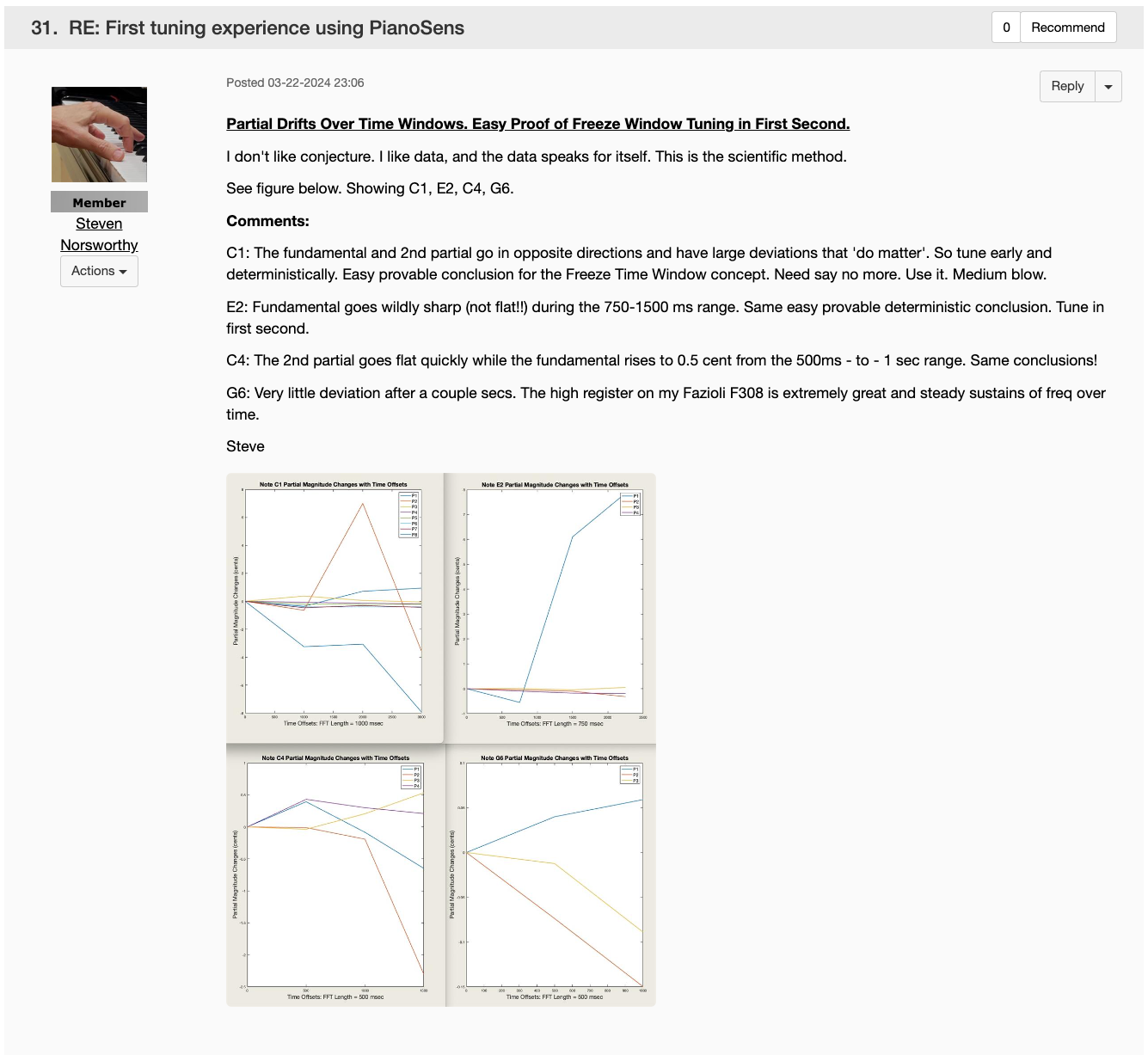
    Here are the same 4 graphs for the note C5. (I unintentionally shuffled the order when creating the collage, so while the 1st graph is still from the mic in the traditional tuning location, the other ones aren't in the same order as in my video.)  Scale on the y axis is increased by 50%.

    There's clearly something going on with Partial #1 around 1.5-2 seconds in this recording. You can see it in the waveform too. ETD users would likely see that as the needle or indicator swinging to the left or right for a second and then going back to normal, or the strobe/phase indicator spinning for a moment and then stopping again. I think most of us are used to seeing things like that. Steven's not wrong when he says that "the piano sound is a moving target". 

    "I appreciate that you are probably placed in a tough spot here as an ETD developer yourself, and may yet face accusations of simply promoting your own product." 

    I hesitated to mention my app in the video for this reason. Also, I should be clear that I in no way meant to throw shade on single-partial ETDs. You can see in the graphs for A2 that Partials 3 & 4 are stable in position and time, and I suspect that TuneLab and CyberTuner would be using one of those partials for A2. I remember back in February you (Nathan Monteleone) did a video of TuneLab where you placed your iPad in a bunch of different locations while playing the note C4. You showed that it gave basically the same reading no matter where the iPad was located. I actually followed your lead and made a video in some client's home of PianoMeter doing the same thing, but I never shared it anywhere. 


    ------------------------------
    Anthony Willey, RPT
    http://willeypianotuning.com
    http://pianometer.com
    ------------------------------


  • 12.  RE: A review of Steven Norsworthy's YouTube video: The Piano Sound is a Moving Target

    Registered Piano Technician
    Posted 06-27-2024 16:31

    I remember back in February you (Nathan Monteleone) did a video of TuneLab where you placed your iPad in a bunch of different locations while playing the note C4. You showed that it gave basically the same reading no matter where the iPad was located.

    Looking at the graphs you just posted, I need to retry that experiment and select a higher partial.  Seems like it's mainly the fundamental that goes wonky.


    ------------------------------
    Nathan Monteleone RPT
    Fort Worth TX
    (817) 675-9494
    nbmont@gmail.com
    ------------------------------


  • 13.  RE: A review of Steven Norsworthy's YouTube video: The Piano Sound is a Moving Target

    Posted 06-27-2024 16:35

    Indeed, the fundamental is of course what we hear the most, and it has a very significant Weinrich Drift off the attack. Let's all make sure we are using all 3 strings in our graphs, unmuted.

    In one sense, what is the point in just showing the mean of the changes of the partials if we are hearing the fundamental the most and it is the wildest one fluctuating?

    If we show the standard deviation of the changes in the partials, it is significant. From my experiments the standard deviation is at least 1 cent from time slot to time slot. 

    As I stated in my original video, what is the basis of the piano tuner's choice of picking a time window? I addressed that rhetorical question with answers in my video. Go back and review what I said. It has to do with both the power level (highest in the first second after the attack) and the music aspects of the nature of the piano musical literature. Now, I would revise and add to that the importance of the fundamental and our perception of it.

    Steve


    ------------------------------
    Steven Norsworthy
    PianoSens
    Cardiff By The Sea CA
    (619) 964-0101
    ------------------------------


  • 14.  RE: A review of Steven Norsworthy's YouTube video: The Piano Sound is a Moving Target

    Registered Piano Technician
    Posted 06-27-2024 18:18

    This is looking better, though I'm having some difficulty interpreting the last set of graphs. Nonetheless, AFAICS this all simply confirms what Gabriel Weinrich wrote about back in 1979 as well as what Virgil Smith wrote about much later, not to mention what Steve N. has been writing and talking about. 

    Personally I'd like to see more cooperation in this endeavor as opposed to competition. If you guys could all put your heads together on it I think it would be more beneficial for all of us. It seems to me that the tools for recording and the software for analyzing is better than ever now. 

    As to defining the best spot for determining unison tuning, my position is that technically speaking the first half second would be optimal, however if the resulting unison sounded stale or sterile or short or whatever as a result, I would try tweaking it a little to see if I could improve it. If I could not, I'd put it back there and move on. 

    My mentor taught me how to do it in an analog procedure. He could do it extremely well.  I believe there is room at the table for both dead on unisons and slightly spread unisons. 

    Peter Grey Piano Doctor 


    ------------------------------
    Peter Grey
    Stratham NH
    (603) 686-2395
    pianodoctor57@gmail.com
    ------------------------------


  • 15.  RE: A review of Steven Norsworthy's YouTube video: The Piano Sound is a Moving Target

    Registered Piano Technician
    Posted 06-27-2024 18:46

    This is looking better, though I'm having some difficulty interpreting the last set of graphs. Nonetheless, AFAICS this all simply confirms what Gabriel Weinrich wrote about back in 1979 as well as what Virgil Smith wrote about much later, not to mention what Steve N. has been writing and talking about. 

    IIUC these are single string measurements, so if you're talking about the bumps and dips in the fundamental around the 1-1.5s mark, I don't think those have anything to do with the unison coupling effect from Weinreich.  It's probably more of a mic measurement artifact from reflections, phase cancellation, or something to that effect.  My own take-away is that when using a mic (for better or worse) I may need to either use the reading from right after the attack, or wait a couple seconds for the pitch to settle out.  Or, as I only just realized, try a higher partial.


    ------------------------------
    Nathan Monteleone RPT
    Fort Worth TX
    (817) 675-9494
    nbmont@gmail.com
    ------------------------------


  • 16.  RE: A review of Steven Norsworthy's YouTube video: The Piano Sound is a Moving Target

    Posted 06-27-2024 19:01

    Nathan, all my published measurement unless otherwise noted, are fully coupled unmuted unisons. The single strings do not exhibit the Weinrich characteristic but look more like simple exponential decays. --- Steve N.


    ------------------------------
    Steven Norsworthy
    PianoSens
    Cardiff By The Sea CA
    (619) 964-0101
    ------------------------------


  • 17.  RE: A review of Steven Norsworthy's YouTube video: The Piano Sound is a Moving Target

    Registered Piano Technician
    Posted 06-28-2024 01:36

    Steve, thanks for the clarification, I was making a false assumption. So what we are seeing on the graph is all 3 strings, all the partials are perfectly in tune and stay that way, in phase, throughout the duration of the period shown. Is that correct or is there some sort of averaging involved in the analysis?


    ------------------------------
    Steven Rosenthal RPT
    Honolulu HI
    (808) 521-7129
    ------------------------------


  • 18.  RE: A review of Steven Norsworthy's YouTube video: The Piano Sound is a Moving Target

    Posted 06-28-2024 10:55

    I have a PART 2 video to The Piano Sound Is a Moving Target. I posted this as a separate thread but somehow it didn't show. 

    https://youtu.be/KIxAY4u__gQ


    Here is the first review on YouTube From Rick Clark

    Rick Clark
    Great work! My whole life I have tuned on the sustain tail, whether by ear or ETD, because that was really the only way we could tune. I look forward to using a new method snap-shotting the pitch a fraction of a second in as suggested by your work and hearing the aesthetic result as music is played. The idea of tuning to a better standard than has ever been possible before in history is very exciting.


    ------------------------------
    Steven Norsworthy
    PianoSens
    Cardiff By The Sea CA
    (619) 964-0101
    ------------------------------


  • 19.  RE: A review of Steven Norsworthy's YouTube video: The Piano Sound is a Moving Target

    Registered Piano Technician
    Posted 06-28-2024 11:58

    I notice you are still arbitrarily defining the offset as "zero" for all the partials in the first time window. 

    Anyway, that's not what I was coming here to say. I actually wanted to respond to your implication that I'm "bending" the data in my analysis due to bias. I'm not sure why I would want to bend data, or what I would be trying to "bend" it to show. The data is what it is, regardless of how you analyze it. So in an effort at transparency, I'm making the 8 recordings I analyzed publicly available at the following link: Steinway D, 2 notes, 4 sensors. You are welcome to run these recordings through your own script and publish your critique. Or we could compare notes and maybe learn something from each other if your analysis comes out different than mine. If I made a mistake in my analysis I'd be grateful to have it pointed out to me. 


    ------------------------------
    Anthony Willey, RPT
    http://willeypianotuning.com
    http://pianometer.com
    ------------------------------


  • 20.  RE: A review of Steven Norsworthy's YouTube video: The Piano Sound is a Moving Target

    Posted 06-28-2024 12:37

    Anthony,

    I 'stand by my original findings' and the video is here:

    https://youtu.be/LPG32Kr1nKM

    I also show the invariance of the sensor to placement. That video is here:

    https://youtu.be/xUfOnQWWoD4

    I also stand by the 'fact' that the sensor is 'invariant' to this because it only looks at string movement. Acoustic (mic) variance in frequency comes from the thousands of eigenmodes of the soundboard which tilt the spectral peaks. I suggest you get a better resolution of the spectral peaks intra-bin. Again, the sensor only looks at string movement, not acoustic waves coming off the soundboard.

    I don't need to analyze someone else's data when I have the facts of the physics and proof of my own experiment.

    If your experiments are showing to the contrary then I can 'assure you' that there is something fundamentally wrong with your analysis. I am confident, fully confident in my findings. It was independently vetted my partner, MIT-PhD Prof. emeritus, who did the experiment himself and came to the same findings.

    Given all the above, why would I be spending time debunking another finding?

    Steve N.


    ------------------------------
    Steven Norsworthy
    PianoSens
    Cardiff By The Sea CA
    (619) 964-0101
    ------------------------------


  • 21.  RE: A review of Steven Norsworthy's YouTube video: The Piano Sound is a Moving Target

    Posted 06-28-2024 16:15

    Some are basically denying the concept of mic variation on frequency having a significant impact on tuning accuracy, and denying the concept of the invariance of the sensor. I posted and reposted the videos on these concepts above.

    I said in my last post that I would not spend any more time refuting a refute, since this is old research for me that originally started the development of the sensor as a mic replacement for tuning with significant improvements to the 'jitter' and 'variation' that is so common with ETD's using a mic. 

    But for my own research sake, I created a new way of looking at the problem by studying all the partial variations with the mic variations, and comparing with the sensor. Mind you, the note C5 is again being used since I originally posted the video with C5.

    Here is a picture over my Fazioli F308 using Newmann KM183 omni mics. The left mic is over the hammer area of E2. The right mic is over the hammer area of F6. The sensor is positioned over C5. 

    Below the photo are three graphs: Partials P1-P4 with the Left Mic, Right Mic, and Sensor.

    Notice how dramatically different your tuning would be from these three graphs. Not shown is that even small subtle changes in the positions of the Left and Right Mics has a large change in the partial spectrograms. The Sensor simply records string movement and even large longitudinal changes up and down the string from the bridge (shown) towards the hammer have little effect. I have explained how there are thousands of eigenmodes of resonance positionally all over the soundboard, each of which will 'tilt' the spectrum and cause the intra-bin frequency of the FFT to change several cents. This is not the case with the sensor. The Right Mic fundamental is nearly 3¢ flat relative to the Left Mic after 2 seconds. The sensor graph has far less spread and is more uniform overall.

    I need to rest my case, which I promised to do on this subject, but now the ammo that I have is even more compelling. 

    Steve N.

    Neumann KM183 Mics over the Fazioli F308
    C5 Left Mic Pickup
    C5 Right Mic Pickup
    C5 Partial Drifts picked up from Sensor


    ------------------------------
    Steven Norsworthy
    PianoSens
    Cardiff By The Sea CA
    (619) 964-0101
    ------------------------------


  • 22.  RE: A review of Steven Norsworthy's YouTube video: The Piano Sound is a Moving Target

    Registered Piano Technician
    Posted 06-28-2024 17:44

    Three questions: 

    1. I noticed that these new graphs show zeros for the first two time windows instead of just the first window.
      Am I correct in assuming that you added zeros to the front end of your data, and not that all the partials in both the first and second time windows happened to have the same frequency? 
    2. Ok, so you don't want to waste time analyzing the data I uploaded. Are you willing to upload the sound files you analyzed so I can run them through my Matlab script? I think it would be helpful to know if we're comparing apples to apples here. 
    3. I was hoping you could clarify what you wrote above: "I also show the invariance of the sensor to placement." I remember you saying at other times that the sensor must be placed near the agraffe or the bridge termination, otherwise it gives inaccurate results. (This was in the context of you saying that Loren Kelley's test was invalid because he wasn't consistent in where he placed the sensor.)


    ------------------------------
    Anthony Willey, RPT
    http://willeypianotuning.com
    http://pianometer.com
    ------------------------------


  • 23.  RE: A review of Steven Norsworthy's YouTube video: The Piano Sound is a Moving Target

    Posted 06-28-2024 18:36

    (edited with my apology).... Anthony, I propose we take this down a notch and even have a phone call discussion.

    As for how Pianometer responds to the sensor, talk to Peter Grey. He has already publicly stated that the sensor calmed it down and far less variation than using a mic. As for a Freeze Window, it helps knowing where in time to put the hammer down. 

    As for the Y axis zero, it means that at the end of 500 msec, we have a reference of zero 'derivative'. What you should be understanding is that the Y axis is a derivative, or the change of the end point of the window with respect to the end point of the prior window. The end of the first window is 500 msec so there is the reference point for the next change, which is a window from 250-750 msec, so at the end of 750 msec we have a derivative or change from the end of the first window that is from 0-500 msec. 

    The sensor placement has virtually no variation of reading in frequency but in amplitude it of course varies because we are at different phase points of the partials. 

    Steve N


    ------------------------------
    Steven Norsworthy
    PianoSens
    Cardiff By The Sea CA
    (619) 964-0101
    ------------------------------


  • 24.  RE: A review of Steven Norsworthy's YouTube video: The Piano Sound is a Moving Target

    Posted 06-29-2024 01:39

    As for the Y axis zero, it means that at the end of 500 msec, we have a reference of zero 'derivative'. What you should be understanding is that the Y axis is a derivative, or the change of the end point of the window with respect to the end point of the prior window. The end of the first window is 500 msec so there is the reference point for the next change, which is a window from 250-750 msec, so at the end of 750 msec we have a derivative or change from the end of the first window that is from 0-500 msec. 
    The sensor placement has virtually no variation of reading in frequency but in amplitude it of course varies because we are at different phase points of the partials.


    ------------------------------
    Steven Norsworthy
    PianoSens
    Cardiff By The Sea CA
    (619) 964-0101
    ------------------------------


  • 25.  RE: A review of Steven Norsworthy's YouTube video: The Piano Sound is a Moving Target

    Posted 06-27-2024 18:56

    Peter,

    There is a lack of perspective going on. it is all about 'business' issues: 

    1) First, personally, I am in the 'research business'. Think of me as a University Prof. or Independent. I write my own analysis software for my own research.

    2) The Piano Tuning App Business is a 'Business' and is for Commercial Use, with the following characteristics:

         a) The Market is Very Small.

         b) The Profit Dollars for the App Makers are Very Low. Most App Makers have another full time job.

         c) The App Makers Are Doing Their Best To Protect Their Product and all of their Intellectual Property. They don't share that.

         d) Anything that sheds light on an app deficiency is not welcomed, but considered adversarial no matter how it is presented.

         e) Tuners are not engineers and are left mystified as to the real 'science' behind the tuning math and signal processing going on.

    Hope that helps.

    Steven Norsworthy

    CEO/President, RF2BITS, Inc.

    http://RF2BITS.com


    ------------------------------
    Steven Norsworthy
    PianoSens
    Cardiff By The Sea CA
    (619) 964-0101
    ------------------------------


  • 26.  RE: A review of Steven Norsworthy's YouTube video: The Piano Sound is a Moving Target

    Registered Piano Technician
    Posted 06-28-2024 12:06

    OK, I tried it out at a higher partial -- I posted it in the ETD group instead since it's, well, straying a bit from theory that can be applied to anything besides ETD usage: https://my.ptg.org/discussion/followup-on-tunelab-mnic?ReturnUrl=%2fcommunities%2fcommunity-home%2fdigestviewer%3fcommunitykey%3d845e61d7-8992-45cc-965b-018c4ec398d5


    ------------------------------
    Nathan Monteleone RPT
    Fort Worth TX
    (817) 675-9494
    nbmont@gmail.com
    ------------------------------


  • 27.  RE: A review of Steven Norsworthy's YouTube video: The Piano Sound is a Moving Target

    Registered Piano Technician
    Posted 06-30-2024 17:49

    Follow-up question on this one for Anthony: In your original video you show the results of averaging the partials.  It's been a hot minute since I took statistics but, aren't there other methods that are better at reducing the influence of statistical outliers, that might give an even more stable reading?  I realize you might have just used average in the video for simplicity's sake.

    I suppose that only applies if the deviations at any given partial are independent of one another.  Looking at the graphs, I almost want to say that an noticeable dip in one of the partials almost seems to be correlated with a slight rise in the others.  But I could be overthinking it...


    ------------------------------
    Nathan Monteleone RPT
    Fort Worth TX
    (817) 675-9494
    nbmont@gmail.com
    ------------------------------


  • 28.  RE: A review of Steven Norsworthy's YouTube video: The Piano Sound is a Moving Target

    Registered Piano Technician
    Posted 06-30-2024 18:36

    OK, so let me clarify. 

    When I said I was using the average, I was basically taking the average frequency of each partial over the entire 3-second piano note. I did this for each individual partial from each individual sensor (3 mics and one pickup). 

    Here's the actual data from the C5 note. 

    After I had an average frequency reading from each sensor, I averaged the four frequencies from the four sensors together to get a single average frequency for each partial. Those are the numbers on the right. You can see that the measured frequencies are all really close to each other (standard deviation under 0.2 Hz even for the worst one). 

    Then I went back to the original "partials over time" data and calculated the cents offset for each time window relative to the 4 "average" frequencies in the table above. So each partial is being measured and analyzed independent of the others, and they're all being plotted on a consistent scale so you can directly compare one graph to the others. When you see one partial go up and 3 others go down, it's because that's just what they happened to do, and not a result of how I analyzed the data. 

    The point of this exercise wasn't to find a way to get a stable reading. It was to demonstrate that there are better ways to graph the data than just using whatever random frequencies happened to show up in the first time window (hammer strike to 0.5 seconds) as the standard against which you're plotting all the following dots. 

    There is a better way still to plot these that I didn't do, but that I plan to at some point in the future when I find the time. It is to calculate target frequencies for the partials based on an inharmonicity model of the string and plot the deviation over time from those the targets. That's what Frank Illenberger was doing in the video he uploaded on PianoWorld. (Here's a link to that: https://www.youtube.com/watch?v=lWZXgrvFolU


    ------------------------------
    Anthony Willey, RPT
    http://willeypianotuning.com
    http://pianometer.com
    ------------------------------


  • 29.  RE: A review of Steven Norsworthy's YouTube video: The Piano Sound is a Moving Target

    Registered Piano Technician
    Posted 06-30-2024 19:28

    Apologies for any confusion -- I understand the _main_ point of the video is to show a way of graphing the deviation of the partials from a meaningful zero point, i.e. without randomly biasing them based on a single time window.  If I got you properly just now, you explained that there were a couple steps of averaging that you used to do that in the first place.  Appreciate the additional info :)

    But if I understood the video right, there's a third type of average that you illustrate with a thick line around 17:45 in the video, that represents what a multi-partial ETD comes up with by averaging the partial pitches at any given time.  That's the operation where I was curious if there was an even snazzier way of doing it.


    ------------------------------
    Nathan Monteleone RPT
    Fort Worth TX
    (817) 675-9494
    nbmont@gmail.com
    ------------------------------


  • 30.  RE: A review of Steven Norsworthy's YouTube video: The Piano Sound is a Moving Target

    Registered Piano Technician
    Posted 06-30-2024 19:49

    Oh! That. Don't read too much into that. I literally just eyeballed that line in PowerPoint and then copy pasted it onto the other graphs.

    Anthony Willey

    (Sent from my mobile device)


  • 31.  RE: A review of Steven Norsworthy's YouTube video: The Piano Sound is a Moving Target

    Registered Piano Technician
    Posted 06-30-2024 20:08

    Gotcha, thanks.


    ------------------------------
    Nathan Monteleone RPT
    Fort Worth TX
    (817) 675-9494
    nbmont@gmail.com
    ------------------------------


  • 32.  RE: A review of Steven Norsworthy's YouTube video: The Piano Sound is a Moving Target

    Posted 06-30-2024 20:12

    Why did Peter Grey find that the sensor substantially clamed down Pianometer? Spread reduction, lowering the standard deviation of the spread.

    Look at the video I posted last night about Spatial Position. If you have more spread (differential frequency deviation on the Y axis) of the partials and average them, you still have a standard deviation that is wide reflecting the wide spread. That wide standard deviation will result in a jittery display and therefore partial averaging does not necessarily calm down the jitter, since the standard deviation is reflected as seeing the indicator jumping around. A solution, as I point out in the video last night, is presented.

    Watch the video. 

    https://youtu.be/26zskT_GvkA

    Steve N.


    ------------------------------
    Steven [Norsworthy
    CEO/President
    RF2BITS, Inc.
    Cardiff CA
    619-964-0101
    steven@rf2bits.com
    ------------------------------


  • 33.  RE: A review of Steven Norsworthy's YouTube video: The Piano Sound is a Moving Target

    Posted 06-28-2024 16:49

    I found the video interesting and this offers a probable explanation of why I would find some notes on some pianos using Verituner(multi-partial) that would show an unstable display. I always assumed it was poor measuring on the displayed note or referenced notes for stretch, but unstable single partials makes sense by skewing the averaging of the strongest sounding partials over time.

    In fact that presents a case against using the sensor for multi-partial tuning since Steven confirmed that the partial strengths measured at the string level don't match the partial strengths filtered through the soundboard into the room, possibly causing a change in how an app drives the display.

    My takeaway from all of the graphs is to simply use a single partial with an app that measures inharmonicity of all the needed notes(to avoid the estimating that just measuring a few notes requires) and just cycle through the partials to choose the one that is most stable through the sustain of the note.

    I tried that today using PiaTune on a Kimball console and ended up with the sweetest tuning ever on that little beast.

    Ron Koval


    ------------------------------
    Ron Koval
    CHICAGO IL
    ------------------------------


  • 34.  RE: A review of Steven Norsworthy's YouTube video: The Piano Sound is a Moving Target

    Posted 06-30-2024 18:33

    Anthony, I agree with others' accolades – very professional job in clarifying and correcting some of the content of Steven N's post. Like explaining the pseudo-issue of using a microphone at a certain position versus using a magnetic pickup, or the perceived need to use an ETD that does its analysis near to the attack time.


    Steven, you might want to re-think your discussion of mis-tuned unisons, such as the unison you demonstrate at around 12:30 in https://www.youtube.com/watch?v=MraLJ4wx-Sk IMHO that "no" PTG tuner is going to set a unison at C5 beating at 1 bps / Hz (beats per second / Hertz) like you demo. Your unison (at 10:30) runs around 0.125 bps at C5 which is more realistic in my experience.


    Also for Steven, you said earlier in this thread that in your measurements you use "fully coupled unmuted unisons," and not individual strings, and you repeat that at 2:00 in your video https://www.youtube.com/watch?v=KIxAY4u__gQ . I find the C6 (at 13:00 in the same video) to be strident and the C7 (at 14:30) to be thin, not what I expect from a 10-foot Fazioli. Might the recording be of single strings after all, or is it my hearing aids!


    Finally, can someone point me to a video showing how a magnetic sensor (like what Steven sells) is used in the tuning of a smaller-sized upright? I am particularly interested in its use for the upper half of the scale.


    All – enjoy Reno. Regards, Norman


    ------------------------------
    Norman Brickman
    Potomac Piano Service
    Potomac, Maryland
    potomacpiano@verizon.net
    https://potomacpiano.com
    (301) 983.9321
    ------------------------------


  • 35.  RE: A review of Steven Norsworthy's YouTube video: The Piano Sound is a Moving Target

    Posted 06-30-2024 18:36

    Norman and Anthony,

    What is to correct? Be specific and be scientifically accurate in context. I answered the only issue of the 'derivative of frequency' where the zero reference starts. Everything else is technically 100%. 

    Here is a challenge: go take my last 3 videos to the top spectrum analyst you can find, to to MIT or Stanford, for example, and find the top professor there on that subject. Have him review the videos. I have already done this. It's your turn. 

    Steve N.


    ------------------------------
    Steven Norsworthy
    CEO/President
    RF2BITS, Inc.
    Cardiff CA
    619-964-0101
    steven@rf2bits.com
    ------------------------------