So...my experience has been that whenever this subject is discussed ("perfect" vs "imperfect" unisons), ALWAYS it gets misconstrued as advocating sloppiness, when in fact this far from the case.
Everyone here knows that when you tune any unison as "dead on perfect" as you can, and then take one our super-micro-accurate ETD's and measure the actual frequencies of the individual strings, they are NEVER exactly the same. Then, using the ETD to tune each individual string to EXACTLY the same frequency and play the unison it often does not sound "as good" to us as when we tuned it without the ETD. This is an interesting phenomenon.
This brings up the obvious question: "What constitutes a 'perfect dead on' unison"? And relatedly: "What constitutes 'mis-tuning'?"
Virgil Smith never advocated introducing "beats" into unisons. He did however advocate not tuning what is commonly referred to as "dead on perfect" unisons. Moat of us highly respected his viewpoint on things (although not necessarily in total agreement) but he certainly had the fruitage to prove his standpoint.
Just as there is latitude in choosing octave widths in one's tuning scheme, there is also latitude in "tuning" unisons (believe it or not). Of course our "training" focuses on "dead on perfect unisons", but just as Virgil eventually found that he could "color" the sound as he tuned the unisons (without creating beats) so can we. I'll tell you that it took me over a year and a half to be able to consistently do this (cuz it ain't easy) after reading and assimilating Virgil's 'Superior Techniques" book, but there is digestible food in there.
Orman Pratt, who mentored me, Rick Butler, and others, had the skill to tune the most PERFECT unisons I ever heard. He taught me his method which I used for years. However, when I would play a piano he had just tuned, of course everything was "perfect"...but I found myself literally becoming anxious and uncomfortable as I was playing. It took me quite some time to figure out that the problem was that it was just "too perfect"...that was the problem. My musical ear wanted something to "happen" after playing a note...and nothing was happening. It just stood still, and those notes that sounded like they were "about to do something" were pulled in to stillness by the bridge so quickly that they didn't "do anything", and that phenomenon bothered me more than the notes that actually "did nothing". So...technically perfect, but musically wanting somehow. I still always admired his ability to tune the thing so "perfect". (And BTW, it was ODP that supplied me with the Weinrich articles early on...yes entrainment/coupling is a "thing" that happens, but we can use this fact to advantage, which is what I believe Virgil Smith was trying to say but did not actually know how to elaborate on it).
Okay so now that I've said all this stuff I'm sure I'm going to get some flack. But go ahead. I can take it.
Peter Grey Piano Doctor
------------------------------
Peter Grey
Stratham NH
(603) 686-2395
pianodoctor57@gmail.com------------------------------
Original Message:
Sent: 09-19-2022 13:04
From: David Pinnegar
Subject: Piano tuning perfectionist nightmare
Ed - thanks
That lecture is interesting but doesn't actually explain the whole story ;-)
Although I can hear a few places where unisons aren't as laser-like as I'd advocate
https://youtu.be/6SPqHBWGMbE?t=2637 might sound different to normal tuning and in particular is there a noticeable calm, a stillness, to the sound? The different tuning concept allows the pianist to extend sustain technique.
Best wishes
David P
--
- - - - - - - - - - - - - - - - - - - - - - - -
David Pinnegar, B.Sc., A.R.C.S.
- - - - - - - - - - - - - - - - - - - - - - - -
+44 1342 850594
Original Message:
Sent: 9/19/2022 11:32:00 AM
From: Edward Foote
Subject: RE: Piano tuning perfectionist nightmare
Greetings,
The discussion of "Mis-tuned unisons" is treated thoroughly in Gabriel Weinreich's article "Coupled motion of piano strings" in "Five Lectures on the acoustics of the piano".
Regards,
A very interesting discussion. A detuned (slightly) unison will last longer as the energy from one string bounces into and out of the other two.... -posted to the "Pianotech" community
| Re: Piano tuning perfectionist nightmare | | | | | A very interesting discussion.
A detuned (slightly) unison will last longer as the energy from one string bounces into and out of the other two. This adds to the fashion of the modern (cross strung post 1870s) pianos to present a glistening and the effect adds to the constant conflict of the 5th harmonic with the equal tempered third.
As those who know who might follow my work I'd fail my PTG exams as I'm not tuning the standard way, but am tuning for the best - youtu.be/9oYEStjnncQ
In the Essay upon Tune by Maxwell, 1781, "being an attempt to free the scale of Music and the tune of instruments from Imperfection", he writes that by spreading the errors of the scale equally over the whole scale the ear is "less shocked". He continues "the consequence would be, that although the ear would never be shocked by gross discord, yet it would never hear good concord".
The standard tuning is one in which nothing is ever still. The demands of the instrument to glisten require notes to be self sustaining in themselves for as long as possible. This has led to very truncated use of the sustain pedal to the extent that for instance I find Haydn fashionably played more or less staccato rather than singing.
In another system of tuning which enables Chopin and Beethoven pedalling to be restored, we want to avoid conflict between sounds, between notes, shorten individual sounds but lengthen the collective when resonance is allowed, giving power to the instrument in the collective resonance rather than the power of individual notes.
In such a regime the target is to achieve laser-like unisons, perfectly together giving greater power to the note for less time and to allow them to add together harmonically mathematically resonantly. Theoreticians among us will be aware of the different harmonic structure of a struck string vs a bowed string and in this way there is a different harmonic series to be achieve within the piano.
This instrument typically can become 6dB more powerful.
Whilst being one of my early experiments and not quite as perfect as I achieve now www.youtube.com/watch?v=7JF3YzTG7lU is an example which has attracted many comments over the years.
This concept of laser-like unisons (which I strive for but don't always achieve), can bring forward a voicing tool. At an international piano competition a competitor complained to me that a note was too loud and asked me to voice it. By fractionally taking the unison off perfect I was able to tone the one note back without interfering with the hammers.
Best wishes
David P
-- - - - - - - - - - - - - - - - - - - - - - - - -
David Pinnegar, B.Sc., A.R.C.S.
- - - - - - - - - - - - - - - - - - - - - - - -
+44 1342 850594
-------------------------------------------
Original Message:
Sent: 9/19/2022 12:39:00 AM
From: Richard West
Subject: RE: Piano tuning perfectionist nightmare
Peter, you said, " Contrary to popular belief, a "dead on" perfect unison (usually) does not sustain as well as one with ever so slightly different frequencies."
Richard replies: In order to reach this perfectionist nightmare, it requires not only knowing what a pure unison sounds like but also how to physically accomplish that task. And, then it requires manipulating a unison to be ever so slightly out of tune to achieve enhanced tone while seeming to preserve the appearance of unison purity.
I agree with this, but it's dangerous. It may be a way for beginning tuners to justify sloppy unisons in the name of better tone. In extreme cases a technician or client may like that little "vibrato" in a unison. That's a different animal. Not to be encouraged as a professional goal or standard.
I give credence to this whole way of thinking because I've heard it from respected tuning teachers and because I've experienced it's opposite-the unison with a false beat that can be manipulated to reduce and even appear to eliminate the false beat. We've all heard three-string unisons with false beats especially in the high treble; they drive us crazy. Sometimes it's possible to "move" or detune or shade one of the three strings slightly and in some cases hide the false beat.
Likewise, in concert tuning I believe it's possible to shade a string of a unison to improve the tone. I don't do it because unisons are so difficult to achieve in the first place, and because the unison will shade itself ever so slightly out of tune as the note is played. In a way seeking absolutely pure unisons ensures that the notes might sound in tune longer. If you shade a string, it's actually leaning toward being out of tune and may require less movement to start to be noticeable. The shaded unison goes from being improved tonally, to being noticeably out of tune. Not what we want in a home situation especially.
I advocate for absolutely pure unisons, because going that ever so slightly bit better is ephemeral, almost religious, which may have some slight benefit in concert situations, but is, as you say,"a tuning perfectionist nightmare." It's good to try tuning out the false beats if you want to practice on an ephemeral skill. But tread carefully. Sloppiness in the name of tonal "improvement" should be avoided.
Richard West
-------------------------------------------
Original Message:
Sent: 9/18/2022 8:06:00 PM
From: Peter Grey
Subject: RE: Piano tuning perfectionist nightmare
Geoff,
The aim is not to "create beats". The aim is to "start a beat" but not complete the cycle. One therefore tries to harness the increase in amplitude of a low partial beat, but the intrainment (coupling) of the bridge "forces" it into unison before it becomes a "beat". At least that's what I try to do.
Contrary to popular belief, a "dead on" perfect unison (usually) does not sustain as well as one with ever so slightly different frequencies. So the bias cut bridge was a way of "forcing" that inequality. Granted, many tuners didn't like it. Plus, if a competitor tended to point to it and refer to it as "a way to compensate for a defect", you can be sure that a manufacturer would delete that pretty quickly.
There is a very interesting Bechstein video on YouTube that discusses this whole topic. The gist of it being that there seems to be a background quality to the sound on a bias cut bridge that creates a beauty that is otherwise missing. At least that's what I got from it.
Finally, I suspect that it is physically challenging to cut the bridge that way accurately...lots of skill needed. If the person who did it died or retired and no one else had the skill to take his place...that would end it quick too.
Peter Grey Piano Doctor
------------------------------
Peter Grey
Stratham NH
(603) 686-2395
pianodoctor57@gmail.com
------------------------------
-------------------------------------------
Original Message:
Sent: 09-18-2022 18:02
From: Karl Roeder
Subject: Piano tuning perfectionist nightmare
I should probably leave this one alone and wait for the smart folks to weigh in. However since it's Sunday and I am (shockingly) not working I just can't help myself. My understanding has been that the deliberate uncoupling of the strings of the unisons in the fifth and sixth octaves is to eliminate the drop in power caused by the coupling effect. The beats caused by the +- 1mm difference in speaking length aren't going to be audible at the fundamental or second partial. If a tuner is listening to any sound higher in the partial spectrum (on a Steinway) than that when tuning a unison they are not likely to get a good result.
One of the most important moments in my career came in 1991 during my first week at Steinway. I was tuning in the Lincoln room just off of the main C&A room in the basement of the old Steinway Hall on 57th Street in Manhattan. As was the custom with all new hires in the C&A department I was tuning the C&A stock pianos one after another so Franz Mohr and Ron Coners could determine what my abilities were as a tuner. Ron was working with me and said that while my temperment, octaves and stability were good there was something just a little off about my unisons. I pointed out a note in the 3rd octave that was driving me nuts because there was a loud beat happening at the 5th partial. When I succeeded in explaining what the 5th partial was and he realized what I was listening to he looked genuinely shocked. After shaking his head in amazement he looked at me and said "That's why your unisons are are off. You have to ignore all those sounds."
It took about a month to re-train my ears and probably another several months before I truly heard the sound of a unison coming from the soundboard through the string noise. Once I heard it my understanding of tuning fundamentally (see what I did there?) changed. Yamaha's great concert technician Ace Ugai has spoken about "tuning in the sonority" to a number of technicians I know and I have long suspected that he's talking about the same thing.
I last saw Ron Coners a couple of years ago at the factory shortly before he retired. He reminded me all those years later how remarkable it was that when I first got to Steinway I was trying to tune listening to all the string noise. We had a good laugh about it.
------------------------------
Karl Roeder
Pompano Beach FL
------------------------------
Original Message:
Sent: 09-18-2022 15:38
From: Geoff Sykes
Subject: Piano tuning perfectionist nightmare
Karl --
> I think the effect of the slightly unequal speaking lengths is greatly exaggerated in the minds of most technicians.
I have only experienced this two, maybe three times, and they were very frustrating experiences. Each time, when I took a look at the bridge and found that it incorporated this design, I pretty much gave up trying to achieve acceptable unisons and went with good enough.
This may be a question for a new thread, but here goes, anyway. The reason for multiple strings in a piano is the increase in power. Acoustically, that means loudness. When you add a second string to a note, and that string is in unison with the original string, you have effectively doubled the power of that note and increased the loudness by 3db. Adding a third string, and having it in unison with the other two, adds half again as much power, or an additional 1-1/2db. Therefore, three strings, in unison, is theoretically providing an increase in loudness of 4-1/2db over a single string. If the unison is out then certain partials start do phase cancel each other out, decreasing power and loudness at those frequencies. If the unison gets far enough out then it starts to create beats. I'm not challenging Steinways methods, I'm just trying to understand how creating beats and decreasing power provides for increased projection. I know several notable techs that deliberately aim for this inaccuracy in their concert tunings for that exact reason, so there's probably something there. Why does this work?
------------------------------
Geoff Sykes, RPT
Los Angeles CA
Original Message:
Sent: 09-18-2022 14:48
From: Karl Roeder
Subject: Piano tuning perfectionist nightmare
Mr. Sykes,
It was explained to me by multiple different people when I was at Steinway that the purpose was to avoid the coupling effect and thus increase the projection and sustain in that part of the scale. Just for what it"s worth I have never had a problem turning unisons on notes with the bridge in that configuration. I think the effect of the slightly unequal speaking lengths is greatly exaggerated in the minds of most technicians.
------------------------------
Karl Roeder
Pompano Beach FL
Original Message:
Sent: 09-18-2022 14:31
From: Geoff Sykes
Subject: Piano tuning perfectionist nightmare
David --
Did any of the articles mention why they chose to do that? Was it deliberate or did they make a long running mistake and then cover it up by saying they meant to do that? And then the obvious follow-up question would be, why did they revert back to equal speaking lengths?
------------------------------
Geoff Sykes, RPT
Los Angeles CA
Original Message:
Sent: 09-18-2022 14:06
From: David Skolnik
Subject: Piano tuning perfectionist nightmare
Spent the last hour re-perusing the Kehl-Kirkland masterpiece Official Guide to Steinway Pianos. It threatened to frustrate me as much as David ever did (nevertheless sorry he's no longer at Steinway), but persistence was rewarded. The first mention of "unequal speaking lengths" is with regard to the Model C (Old curve) (Style 3 - 7 1/4 octaves) 1886 - 1892 - on lower treble section. However, on pg. 179 (last paragraph) they point to the 1884 D as the original model depolying unequal lenghs, though in differing sections: D had them in upper center and lower treble, while C had them only in lower treble. On page 195, in discussing the modern D: "In the 1930's, unequal speaking legths in the lower-treble section were superseded by equal speaking lenghts."
No wonder he always seemed distracted. A belated thank you.
------------------------------
David Skolnik [RPT]
Hastings-on-Hudson NY
(917) 589-2625
Original Message:
Sent: 09-17-2022 14:16
From: Rick Butler
Subject: Piano tuning perfectionist nightmare
That is my understanding. (True)
------------------------------
Rick Butler RPT
The Butler School of Piano Technology
Bowie MD
240 396 7480
RickRickRickRickRick
Original Message:
Sent: 09-17-2022 13:28
From: Geoff Sykes
Subject: Piano tuning perfectionist nightmare
I've always thought that this would be a much more efficient way terminate strings at the bridge. Pretty much guarantees that all the strings are the same length, making unisons easier to pull in, and could possibly eliminate false beating strings due to bridge pin problems. You're telling me that it won't? (-sigh-)
I've come across one model of S&S piano, probably older ones, where the bridge pins aren't anywhere close to providing a uniform string length termination point. Unisons are impossible and I was told that this was a deliberate design to create a piano that would project more. True? False?
------------------------------
Geoff Sykes, RPT
Los Angeles CA
Original Message:
Sent: 09-17-2022 12:40
From: Greg Junker
Subject: Piano tuning perfectionist nightmare
This Sohmer Grand with a player mechanism has a bridge system to enhance an old "out of tune" player sound, with unisons barking like a honky-tonk saloon piano. It is impossible to achieve clear, crisp unisons. False beats on steroids! My customer loves the sound, and that's what counts. 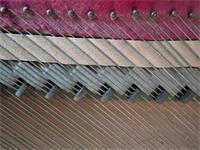
------------------------------
Greg Junker RPT
Greg Junker's Piano Shoppe, LLC
Belleville IL
(618) 971-9595
------------------------------ |
| | Reply to Group Online View Thread Recommend Forward Mark as Inappropriate |
|
|
Original Message:
Sent: 9/19/2022 11:10:00 AM
From: David Pinnegar
Subject: RE: Piano tuning perfectionist nightmare
A very interesting discussion.
A detuned (slightly) unison will last longer as the energy from one string bounces into and out of the other two. This adds to the fashion of the modern (cross strung post 1870s) pianos to present a glistening and the effect adds to the constant conflict of the 5th harmonic with the equal tempered third.
As those who know who might follow my work I'd fail my PTG exams as I'm not tuning the standard way, but am tuning for the best -
https://youtu.be/9oYEStjnncQ
In the Essay upon Tune by Maxwell, 1781, "being an attempt to free the scale of Music and the tune of instruments from Imperfection", he writes that by spreading the errors of the scale equally over the whole scale the ear is "less shocked". He continues "the consequence would be, that although the ear would never be shocked by gross discord, yet it would never hear good concord".
The standard tuning is one in which nothing is ever still. The demands of the instrument to glisten require notes to be self sustaining in themselves for as long as possible. This has led to very truncated use of the sustain pedal to the extent that for instance I find Haydn fashionably played more or less staccato rather than singing.
In another system of tuning which enables Chopin and Beethoven pedalling to be restored, we want to avoid conflict between sounds, between notes, shorten individual sounds but lengthen the collective when resonance is allowed, giving power to the instrument in the collective resonance rather than the power of individual notes.
In such a regime the target is to achieve laser-like unisons, perfectly together giving greater power to the note for less time and to allow them to add together harmonically mathematically resonantly. Theoreticians among us will be aware of the different harmonic structure of a struck string vs a bowed string and in this way there is a different harmonic series to be achieve within the piano.
This instrument typically can become 6dB more powerful.
This concept of laser-like unisons (which I strive for but don't always achieve), can bring forward a voicing tool. At an international piano competition a competitor complained to me that a note was too loud and asked me to voice it. By fractionally taking the unison off perfect I was able to tone the one note back without interfering with the hammers.
Best wishes
David P
--
- - - - - - - - - - - - - - - - - - - - - - - -
David Pinnegar, B.Sc., A.R.C.S.
- - - - - - - - - - - - - - - - - - - - - - - -
+44 1342 850594
Original Message:
Sent: 9/19/2022 12:39:00 AM
From: Richard West
Subject: RE: Piano tuning perfectionist nightmare
Peter, you said, "
Contrary to popular belief, a "dead on" perfect unison (usually) does not sustain as well as one with ever so slightly different frequencies."
Richard replies: In order to reach this perfectionist nightmare, it requires not only knowing what a pure unison sounds like but also how to physically accomplish that task. And, then it requires manipulating a unison to be ever so slightly out of tune to achieve enhanced tone while seeming to preserve the appearance of unison purity.
I agree with this, but it's dangerous. It may be a way for beginning tuners to justify sloppy unisons in the name of better tone. In extreme cases a technician or client may like that little "vibrato" in a unison. That's a different animal. Not to be encouraged as a professional goal or standard.
I give credence to this whole way of thinking because I've heard it from respected tuning teachers and because I've experienced it's opposite-the unison with a false beat that can be manipulated to reduce and even appear to eliminate the false beat. We've all heard three-string unisons with false beats especially in the high treble; they drive us crazy. Sometimes it's possible to "move" or detune or shade one of the three strings slightly and in some cases hide the false beat.
Likewise, in concert tuning I believe it's possible to shade a string of a unison to improve the tone. I don't do it because unisons are so difficult to achieve in the first place, and because the unison will shade itself ever so slightly out of tune as the note is played. In a way seeking absolutely pure unisons ensures that the notes might sound in tune longer. If you shade a string, it's actually leaning toward being out of tune and may require less movement to start to be noticeable. The shaded unison goes from being improved tonally, to being noticeably out of tune. Not what we want in a home situation especially.
I advocate for absolutely pure unisons, because going that ever so slightly bit better is ephemeral, almost religious, which may have some slight benefit in concert situations, but is, as you say,"a tuning perfectionist nightmare." It's good to try tuning out the false beats if you want to practice on an ephemeral skill. But tread carefully. Sloppiness in the name of tonal "improvement" should be avoided.
Richard West
Original Message:
Sent: 9/18/2022 8:06:00 PM
From: Peter Grey
Subject: RE: Piano tuning perfectionist nightmare
Geoff,
The aim is not to "create beats". The aim is to "start a beat" but not complete the cycle. One therefore tries to harness the increase in amplitude of a low partial beat, but the intrainment (coupling) of the bridge "forces" it into unison before it becomes a "beat". At least that's what I try to do.
Contrary to popular belief, a "dead on" perfect unison (usually) does not sustain as well as one with ever so slightly different frequencies. So the bias cut bridge was a way of "forcing" that inequality. Granted, many tuners didn't like it. Plus, if a competitor tended to point to it and refer to it as "a way to compensate for a defect", you can be sure that a manufacturer would delete that pretty quickly.
There is a very interesting Bechstein video on YouTube that discusses this whole topic. The gist of it being that there seems to be a background quality to the sound on a bias cut bridge that creates a beauty that is otherwise missing. At least that's what I got from it.
Finally, I suspect that it is physically challenging to cut the bridge that way accurately...lots of skill needed. If the person who did it died or retired and no one else had the skill to take his place...that would end it quick too.
Peter Grey Piano Doctor
------------------------------
Peter Grey
Stratham NH
(603) 686-2395
pianodoctor57@gmail.com
------------------------------
Original Message:
Sent: 09-18-2022 18:02
From: Karl Roeder
Subject: Piano tuning perfectionist nightmare
I should probably leave this one alone and wait for the smart folks to weigh in. However since it's Sunday and I am (shockingly) not working I just can't help myself. My understanding has been that the deliberate uncoupling of the strings of the unisons in the fifth and sixth octaves is to eliminate the drop in power caused by the coupling effect. The beats caused by the +- 1mm difference in speaking length aren't going to be audible at the fundamental or second partial. If a tuner is listening to any sound higher in the partial spectrum (on a Steinway) than that when tuning a unison they are not likely to get a good result.
One of the most important moments in my career came in 1991 during my first week at Steinway. I was tuning in the Lincoln room just off of the main C&A room in the basement of the old Steinway Hall on 57th Street in Manhattan. As was the custom with all new hires in the C&A department I was tuning the C&A stock pianos one after another so Franz Mohr and Ron Coners could determine what my abilities were as a tuner. Ron was working with me and said that while my temperment, octaves and stability were good there was something just a little off about my unisons. I pointed out a note in the 3rd octave that was driving me nuts because there was a loud beat happening at the 5th partial. When I succeeded in explaining what the 5th partial was and he realized what I was listening to he looked genuinely shocked. After shaking his head in amazement he looked at me and said "That's why your unisons are are off. You have to ignore all those sounds."
It took about a month to re-train my ears and probably another several months before I truly heard the sound of a unison coming from the soundboard through the string noise. Once I heard it my understanding of tuning fundamentally (see what I did there?) changed. Yamaha's great concert technician Ace Ugai has spoken about "tuning in the sonority" to a number of technicians I know and I have long suspected that he's talking about the same thing.
I last saw Ron Coners a couple of years ago at the factory shortly before he retired. He reminded me all those years later how remarkable it was that when I first got to Steinway I was trying to tune listening to all the string noise. We had a good laugh about it.
------------------------------
Karl Roeder
Pompano Beach FL
Original Message:
Sent: 09-18-2022 15:38
From: Geoff Sykes
Subject: Piano tuning perfectionist nightmare
Karl --
> I think the effect of the slightly unequal speaking lengths is greatly exaggerated in the minds of most technicians.
I have only experienced this two, maybe three times, and they were very frustrating experiences. Each time, when I took a look at the bridge and found that it incorporated this design, I pretty much gave up trying to achieve acceptable unisons and went with good enough.
This may be a question for a new thread, but here goes, anyway. The reason for multiple strings in a piano is the increase in power. Acoustically, that means loudness. When you add a second string to a note, and that string is in unison with the original string, you have effectively doubled the power of that note and increased the loudness by 3db. Adding a third string, and having it in unison with the other two, adds half again as much power, or an additional 1-1/2db. Therefore, three strings, in unison, is theoretically providing an increase in loudness of 4-1/2db over a single string. If the unison is out then certain partials start do phase cancel each other out, decreasing power and loudness at those frequencies. If the unison gets far enough out then it starts to create beats. I'm not challenging Steinways methods, I'm just trying to understand how creating beats and decreasing power provides for increased projection. I know several notable techs that deliberately aim for this inaccuracy in their concert tunings for that exact reason, so there's probably something there. Why does this work?
------------------------------
Geoff Sykes, RPT
Los Angeles CA
Original Message:
Sent: 09-18-2022 14:48
From: Karl Roeder
Subject: Piano tuning perfectionist nightmare
Mr. Sykes,
It was explained to me by multiple different people when I was at Steinway that the purpose was to avoid the coupling effect and thus increase the projection and sustain in that part of the scale. Just for what it"s worth I have never had a problem turning unisons on notes with the bridge in that configuration. I think the effect of the slightly unequal speaking lengths is greatly exaggerated in the minds of most technicians.
------------------------------
Karl Roeder
Pompano Beach FL
Original Message:
Sent: 09-18-2022 14:31
From: Geoff Sykes
Subject: Piano tuning perfectionist nightmare
David --
Did any of the articles mention why they chose to do that? Was it deliberate or did they make a long running mistake and then cover it up by saying they meant to do that? And then the obvious follow-up question would be, why did they revert back to equal speaking lengths?
------------------------------
Geoff Sykes, RPT
Los Angeles CA
Original Message:
Sent: 09-18-2022 14:06
From: David Skolnik
Subject: Piano tuning perfectionist nightmare
Spent the last hour re-perusing the Kehl-Kirkland masterpiece Official Guide to Steinway Pianos. It threatened to frustrate me as much as David ever did (nevertheless sorry he's no longer at Steinway), but persistence was rewarded. The first mention of "unequal speaking lengths" is with regard to the Model C (Old curve) (Style 3 - 7 1/4 octaves) 1886 - 1892 - on lower treble section. However, on pg. 179 (last paragraph) they point to the 1884 D as the original model depolying unequal lenghs, though in differing sections: D had them in upper center and lower treble, while C had them only in lower treble. On page 195, in discussing the modern D: "In the 1930's, unequal speaking legths in the lower-treble section were superseded by equal speaking lenghts."
No wonder he always seemed distracted. A belated thank you.
------------------------------
David Skolnik [RPT]
Hastings-on-Hudson NY
(917) 589-2625
Original Message:
Sent: 09-17-2022 14:16
From: Rick Butler
Subject: Piano tuning perfectionist nightmare
That is my understanding. (True)
------------------------------
Rick Butler RPT
The Butler School of Piano Technology
Bowie MD
240 396 7480
RickRickRickRickRick
Original Message:
Sent: 09-17-2022 13:28
From: Geoff Sykes
Subject: Piano tuning perfectionist nightmare
I've always thought that this would be a much more efficient way terminate strings at the bridge. Pretty much guarantees that all the strings are the same length, making unisons easier to pull in, and could possibly eliminate false beating strings due to bridge pin problems. You're telling me that it won't? (-sigh-)
I've come across one model of S&S piano, probably older ones, where the bridge pins aren't anywhere close to providing a uniform string length termination point. Unisons are impossible and I was told that this was a deliberate design to create a piano that would project more. True? False?
------------------------------
Geoff Sykes, RPT
Los Angeles CA